


We’ve seen some noteworthy actions coming out of the Treasury Department recently that are telling the markets that the Treasury isn’t planning to sit on the sidelines. Earlier this month it was the yen, when the US and Japan coordinated to support the currency after it slid toward levels not seen since 1990. More recently it was the treasury market itself, when Scott Bessent doubled the size of the government’s bond buyback program after investors demanded higher yields to absorb roughly $1 trillion of new issuance in three months. These are two very different markets but the story is the same, which is that if the Treasury thinks a market is moving in a way it doesn’t like, they won’t sit on the sidelines.
The recent actions beg the question: How effective were they? As for Japan, the yen intervention didn’t hold, the currency slid back within about a week. This last week’s buyback announcement saw 30-year treasury yields dip and then erase the entire move within a day, although they have eased again more recently (see below).
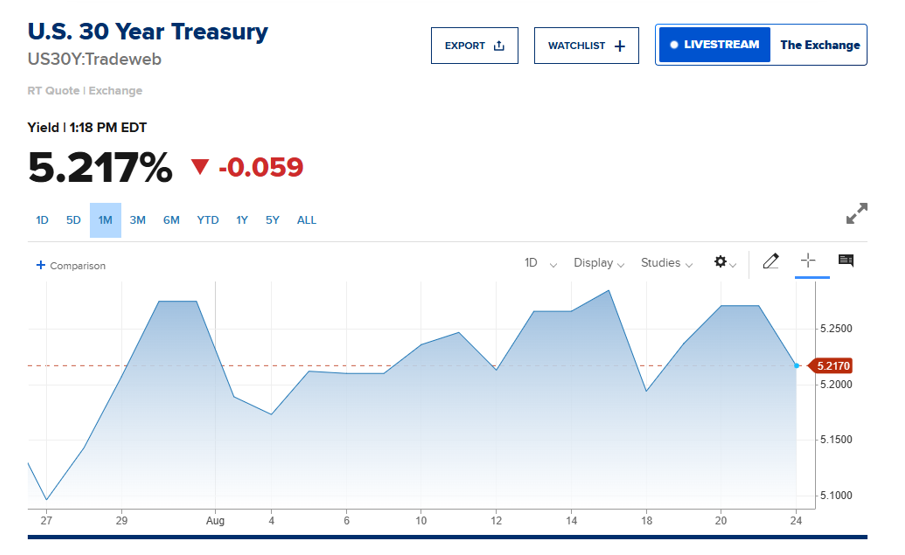
Clearly, the interventions themselves haven’t exactly been clean wins, but we wouldn’t count the Treasury out just yet. Bessent has continued to wave off concern over the $40 trillion debt figure directly (“there’s nothing magic about the number”) while signaling he’s ready to increase buybacks if long-term rates keep climbing.
Jackson Hole: All Eyes on Kevin Warsh
Every August, the Kansas City Fed hosts central bankers, economists, and policymakers from around the world in Jackson Hole, Wyoming, to discuss a broad academic theme. It has also evolved into one of the most closely watched venues for hints about where U.S. monetary policy is headed next. It’s where Bernanke first hinted at a second round of quantitative easing, and where Powell in 2020 used the platform to unveil the Fed’s shift to average inflation targeting. The speeches themselves may be carefully hedged, but market participants tend to parse every sentence for a sign of what may come.
This will be Kevin Warsh’s first appearance at Jackson Hole as Fed chair and we think the stakes are higher than normal because Warsh has already broken from the Powell-era habit of using speeches and press conferences to actively shape market expectations between meetings. This is a meaningful shift in style, and it is leaving the markets with higher levels of uncertainty. Warsh’s style shift comes at what we consider is a complicated moment because long-term yields are under pressure, inflation has cooled but isn’t fully resolved, and the labor market most recently sent some mixed signals.
There is Always a Reason No to Invest; We Like Investing Anyway
If someone wanted an excuse to sit in cash, the last eight months would have handed them half a dozen great ones: a war in the Middle East, an oil shock, a divided Fed under new leadership, a jobs report that broke a three-month winning streak, and a hedge fund unwinding a leveraged AI trade. The list could go on, and there is always a reason to not invest. In fact, the news headlines constantly make staying in cash feel like the responsible choice.
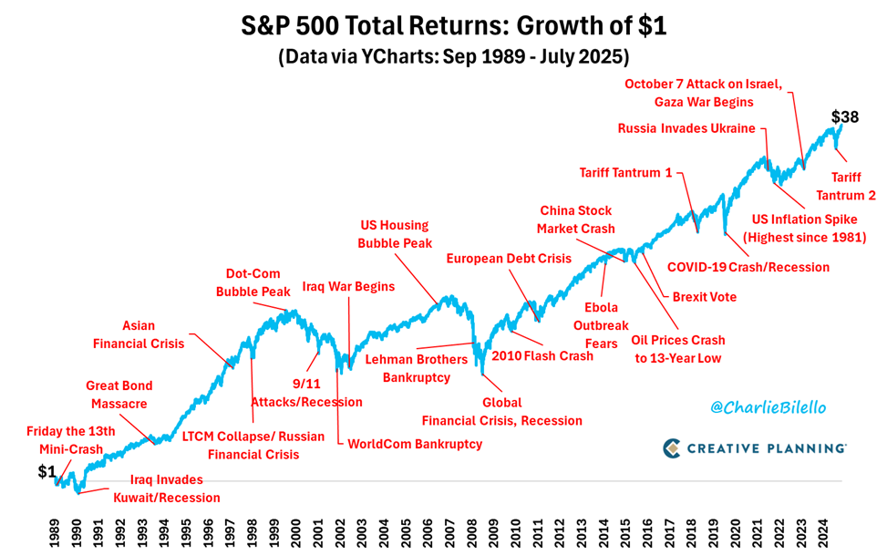
But, the reality is that the data tells a different story. We really like the above chart because it reminds us that there are always great reasons not to invest, but over a sufficiently long time horizon, staying invested through the noise has outperformed waiting for the noise to clear, largely because by the time it clears, the market has already re-priced. For an investor with a long time horizon, the worst decision usually isn’t buying at a bad moment. It’s not being invested at all.
Hope you have a great week, and remember, volatility is the price of admission.
Best,
Park City Investment Solutions Team
This material is for informational purposes only and does not constitute investment advice or a recommendation to buy or sell any security. Opinions expressed are as of the date of publication and are subject to change. Past performance is not indicative of future results.
