

Nvidia lost its co-founder and only CEO last Thursday as Jensen Huang resigned as president, CEO and director with immediate effect on November 12th, after reports of extramarital relationships, including one with a businesswoman whom U.S. intelligence officials reportedly suspect of spying for China, and relationships with company subordinates. The board has opened an investigation into the national-security implications. CFO Colette Kress is interim CEO while the board searches for a permanent replacement, and Harvey Jones has become the company’s first independent chairman. Some large shareholders have urged the board not to rush the search, while a petition calling for Huang’s reinstatement has been signed by some high-profile individuals.
The stock reaction was rough as Nvidia fell as much as 14% intraday on Thursday before closing down 4.3%, then fell another 2% Friday to $162.85. It was down about 13% for the week, its sixth straight weekly decline and longest losing streak since 2012, and it is now roughly 32% below its October 6th record close of $239.24. Its market value has dropped below $4 trillion for the first time since July 2025. The company reports earnings Tuesday, November 17th.
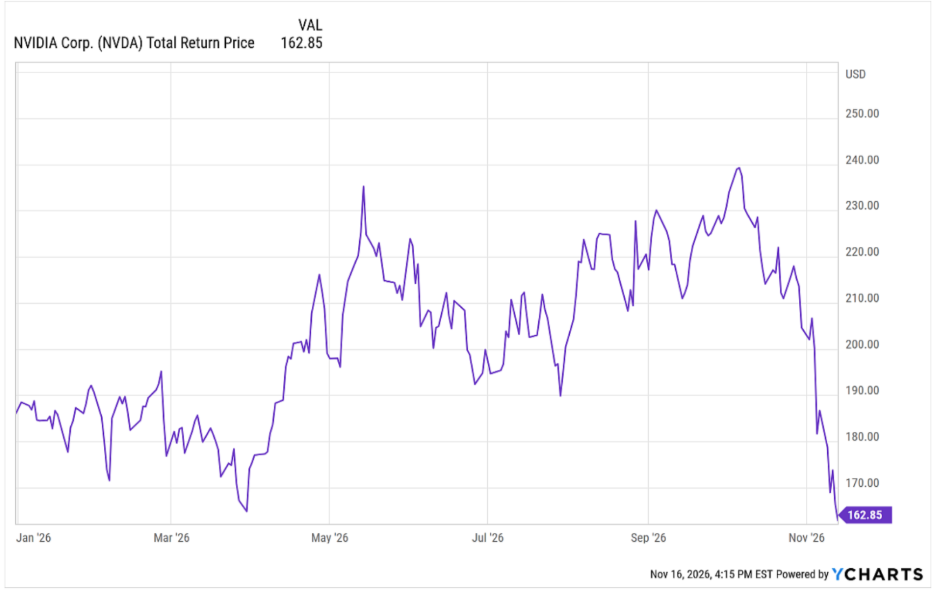
Source: YCharts; Data as 11/13/2026
So, what is the argument to hold or buy at these levels? Firstly, the business has not changed in a week. Last quarter’s revenue was $96 billion, up about 90% from a year ago, data center revenue grew 117%, and production capacity is reportedly sold out well into next year. The stock now trades at about 12 times expected earnings over the next year, the cheapest since 2012 and arguably a low multiple for a company still growing this fast. Wall Street remains largely bullish with 66 buy, 15 hold and 1 sell ratings, and some would say much of the uncertainty is already reflected in the price.
An argument for caution is that the low multiple might be trying to tell us that while growth remains strong for now, it might not necessarily be there in 2028, 2029, or 2030. Additionally, it will be very difficult for a new CEO to fill Jensen’s shoes, not to mention that national security concerns could bring tighter export controls.
No one knows what will happen next, but all else being equal, if you are a believer in the AI story and expect more data center growth in the future, this could be a buying opportunity.
The Mystery of the Missing Inflation Number
The October Consumer Price Index came out last Tuesday, but oddly enough the year-over-year number was missing. The reason goes back to last year’s federal shutdown, which ran from October 1st to November 12th, 2025. Because the Bureau of Labor Statistics could not collect October 2025 prices, it never issued an October 2025 CPI report. Without an October 2025 starting point, there is nothing to measure October 2026 against, and BLS’s stated policy is that it will not publish 12-month changes for any index where last October’s data is missing. For those statistic junkies out there like us, do not worry. The year-over-year figures will return with the November report on December 10th, since the November 2025 prices were collected.
The monthly data, which BLS did publish, was hotter than expected. Headline CPI rose 0.4% in October against a 0.3% consensus, and core CPI (excluding food and energy) rose 0.3% against 0.2% expected, its third straight month at that pace. Over the last three months core inflation is running at about a 3.7% annualized rate. Food rose 0.5%, energy 0.7% and shelter 0.3%, and gasoline is up about 37% from a year ago. Despite the missing data, economists have tried to fill the gap by estimating last October’s index level, usually by averaging September and November 2025. Those estimates put headline inflation at roughly 3.8% to 4.2%, up from 3.7% in September, with most landing near 4%. Core inflation is estimated at about 2.7% to 3.0%, up from 2.6%. See below from JPMorgan:
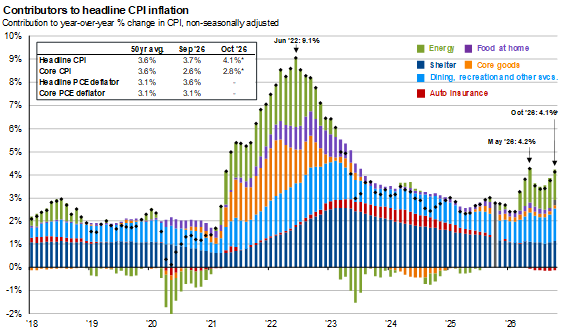
Source: JPMorgan Guide to the Markets
With inflation rising and recent jobs data showing a strong employment picture, a December rate hike now looks like a foregone conclusion. Markets put the odds at roughly 89%, and October payrolls rose 165,000, nearly triple expectations. If there is a silver lining to all of this, it is that energy prices tend to swing significantly. With gasoline up about 37% from a year ago and Brent crude down from about $118 to the mid-$90s, the energy portion of today’s inflation will likely reverse over the next 12 months, though core and services inflation may prove stickier.
The Binance Heist and Crypto’s Rough Month
If you thought Halloween was scary, October 29th was frightening for the cryptocurrency community as hackers stole more than $6 billion in digital assets from Binance, the world’s largest crypto exchange. It is one of the largest thefts in crypto history, and the FBI has attributed it to a North Korean military hacking group. The Justice Department has won court orders to seize or restrain more than $1.2 billion, and counting private-sector freezes, more than $2.7 billion has been frozen. Binance says it set aside about $6.3 billion of its own funds to cover affected customers.
The theft has landed on a market already under pressure. Bitcoin fell from about $81,000 on November 4 to an intraday low near $62,000 this last weekend, a drop of roughly 23% in under two weeks, and traded around $64,000-$65,000 on Sunday. See chart below:
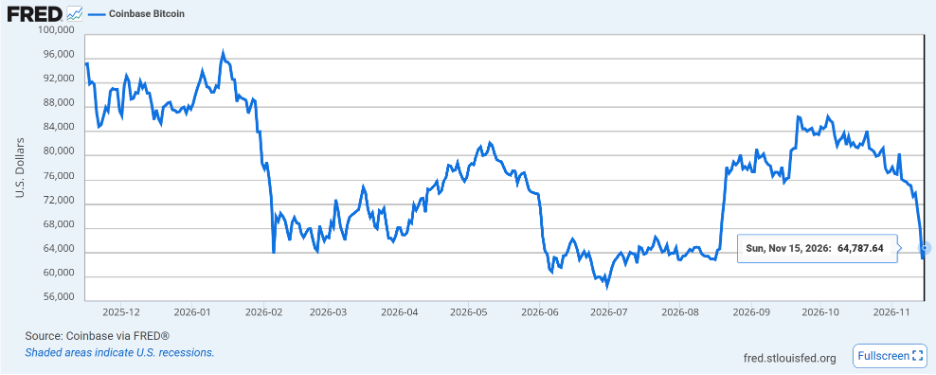
Source: FRED
That is about half its October 2025 all-time high above $126,000. Bitcoin ETFs have seen about $3 billion of net outflows since October 29th, with total ETF assets falling from about $104 billion to $86 billion, and more than $1.7 billion in leveraged positions, mostly bets on rising prices, were liquidated in 24 hours over the weekend. The Crypto Fear & Greed Index fell to 10, deep in “extreme fear.” Analysts are pointing less to crypto-specific news than to the broader environment. Some of these factors include rising short-term yields, the AI stock selloff forcing margin calls, and midterm results that make the crypto Clarity Act unlikely to pass this year.
For people who believe in the long-term case for crypto, this kind of decline has historically been when patient investors have been able to add at much better prices. “Extreme fear” readings, heavy liquidations and capitulating ETF flows have often come near short-term lows, and Bitcoin is now priced roughly where it was before its last big run. For someone who already has a crypto allocation in their portfolio, this may be a reasonable time to rebalance back to target or to add gradually through dollar-cost averaging, rather than trying to pick the bottom. Keep the allocation small enough that another 50% decline wouldn’t change your plans, and favor regulated ETFs or qualified custodians over holding coins on an exchange. With that said, crypto prices are driven heavily by liquidity and sentiment, and “cheaper” can still get cheaper.
Hope you have a great week, and remember, volatility is the price of admission.
Best,
Park City Investment Solutions Team
This material is for informational purposes only and does not constitute investment advice or a recommendation to buy or sell any security. Opinions expressed are as of the date of publication and are subject to change. Past performance is not indicative of future results.
