

Despite market expectations towards the middle of last week being closer to a 60/40 probability of a hike vs. no change, that narrative shifted as more inflation and jobs data hit the news, with the probability of a hike climbing closer to 90% by Friday. And as the market forecasted, the Fed increased its benchmark rate for the first time in three years by a quarter point on Wednesday, moving the target range to 3.75% to 4.00% in a unanimous 12-0 vote.
The Committee framed the move as an effort to support what Chair Kevin Warsh called a “timelier” return to the 2% inflation target, and the updated dot plot showed 16 of 18 participants expecting at least one more hike before year-end, with 12 penciling in a single additional quarter-point move and four calling for two. Warsh again declined to submit his own projection (no surprise there).
What stood out most to us in the post-announcement press conference was how Warsh described the committee’s decision-making process. Asked about last week’s hotter-than-expected CPI print, he pushed back on the idea that any single data release drove the outcome. “Trends matter. Data points are noisy,” he said, adding that “data point dependence is a dangerous preoccupation.” He even went so far as to say that he wasn’t a “data point dependent guy”. Warsh continues to position himself as a trend watcher rather than someone reacting to whatever number crosses the tape that morning. Additionally, Warsh emphasized the continued resilience of the labor market and broader economic strength as giving the committee the green light to prioritize the fight against inflation.
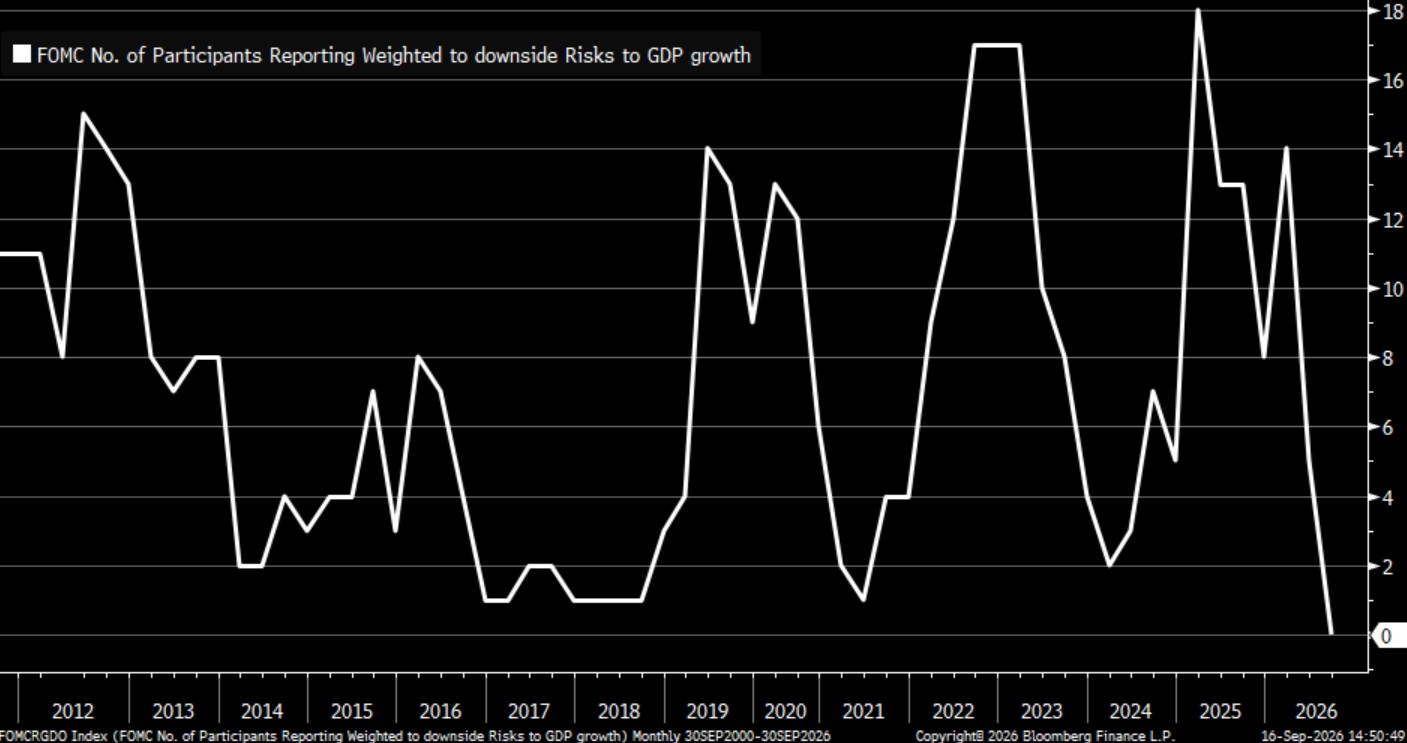
One data point out of the meeting that we found fascinating was the complete lack of downside risk expectations to GDP Growth. Not a single participant reported a concern about downside risks to GDP Growth, an unprecedented datapoint relative to historical data. See the chart below:
Higher Interest Rates for Longer: What Does This Mean for Markets and Individuals?
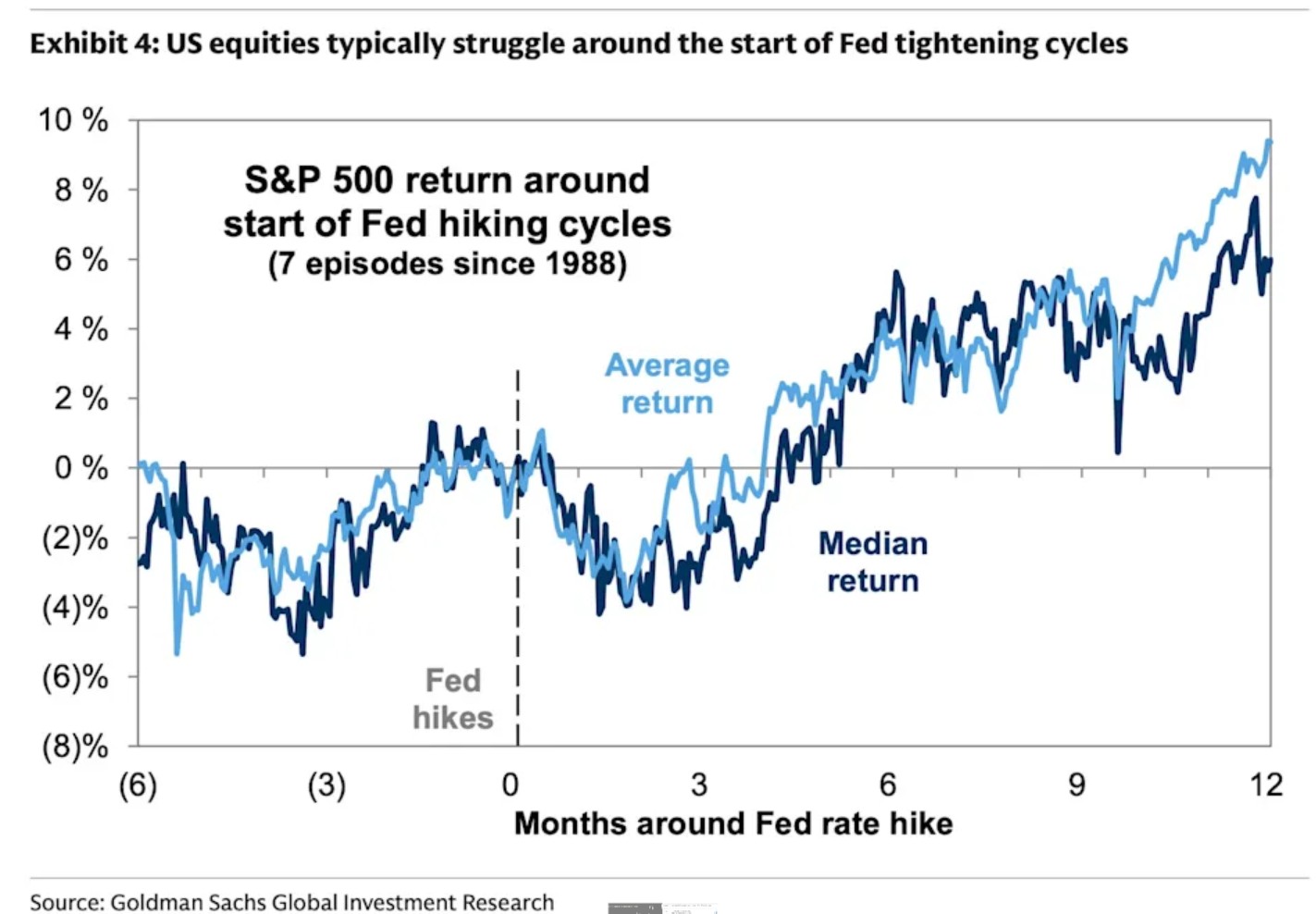
For markets, a higher-for-longer rate path is fundamentally a repricing exercise. At the end of the day, every equity and bond is worth the present value of the cash flows it generates in the future, and the rate used to discount those future cash flows has moved higher. With that said, according to research out of GS, while equities might be a little volatile in the short run after a first hike, over the longer-run, they tend to do well. See below:
For individuals, the effects show up in far more tangible ways. People carrying a credit card balance, a variable rate loan, or shopping for a mortgage in the coming months will likely feel this hike, if they haven’t already. On the other side, savers have some wind at their backs, with money market funds, CDs, and high yield savings accounts becoming a modestly more attractive place to park cash.
And if history is any guide, the Fed isn’t done yet because the Federal Reserve has not stopped with one hike when a new hiking cycle begins. What the Fed knows and that we need to remind ourselves is that rate hikes work with long and variable lags and monetary policy is more akin to a cudgel than a scalpel. History suggests the Fed rarely threads the monetary policy needle well, and the risk of an overtightening mistake rises with each additional hike on top of what we consider is an already restrictive policy rate, despite what Warsh says.
AI: Doomsdayers Debate When AI will End Humanity
For fans of the Dune books, Frank Herbert described wars in his fictional world where humanity fought against “thinking machines” that men thought would set them free and that ultimately enslaved them. So, doomsday theories about AI have been around since at least the early 1960s. And with that thought in mind, it shouldn’t be much of a surprise that last week’s most discussed story about AI had nothing to do with earnings, capex, or whether OpenAI will go public in 2026. But rather, it was a story of a former Anthropic and OpenAI researcher, Jacob Coxon, who resigned publicly and wrote that “the people building AI earnestly believe it could kill us all by the end of the decade.” To add fuel to the fire, another Anthropic employee, Evan Hubinger, responded that he personally believes there is “greater than 10% within the next decade” that AI could kill all humans.
So what do these doomsday claims have The skeptic in us would point to a few incentives:
Prophet complex. People love to set themselves forth as “prophets” to gain power and influence from other people. Regulatory capture. If lawmakers come to believe that only a small number of extremely well-capitalized, safety-focused labs can be trusted with something this powerful, that favors the incumbents already at the frontier and raises the cost of entry for competitors who cannot match that safety infrastructure.
Unbelievably powerful (and valuable) technology. “This technology might end the world” is also a claim that the technology could be worth an enormous amount of money, which is a useful narrative to have in circulation ahead of continued fundraising and eventual public offerings.
While AI has clearly proven to be a powerful tool, our experience and research has shown it to be effective at making people more efficient, which has translated to cost savings at companies and not necessarily widespread job losses or massive revenue generating opportunities. We think we can sleep safely tonight and for many nights to come.
Hope you have a great week, and remember, volatility is the price of admission.
Best,
Park City Investment Solutions Team
This material is for informational purposes only and does not constitute investment advice or a recommendation to buy or sell any security. Opinions expressed are as of the date of publication and are subject to change. Past performance is not indicative of future results.
