

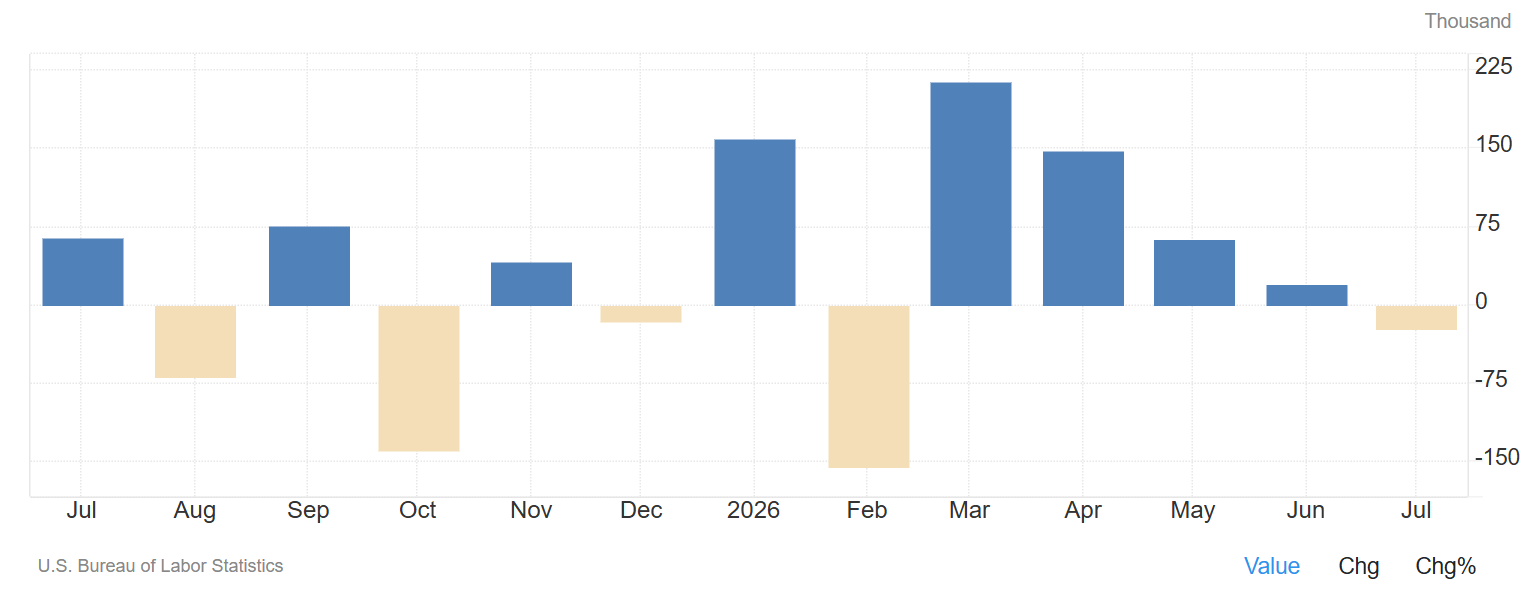
Friday’s employment report was weak, confusing, and the markets liked it. Nonfarm payrolls fell by 23,000 in July, a sharp miss against the Wall Street consensus of roughly 83,000, and the Bureau of Labor Statistics also revised May and June downward by a combined 103,000 jobs (See below chart). Government employment led the decline, shedding 53,000 positions. And yet the unemployment rate somehow ticked down to 4.1%. We spoke about this in the past, but the recent declining unemployment rate isn’t being driven by people finding work, but from a shrinking labor force. Not the most ideal reason for unemployment to decline.
Beyond the weak number and confusing situation around declining unemployment, what makes this report even more interesting was how the market chose to interpret it. A weak jobs report would typically be interpreted as a warning sign for the economy, yet equities rallied into the weekend, with the S&P 500 closing at a fresh record. Why would bad news be good news? Investors concluded that a softer labor market gives the Federal Reserve the room it needs to pause rather than raise rates, and that narrative overcame any concern about underlying economic weakness.
AI Isn’t Coming for Our Jobs, Just Our Pay Raises
Apollo’s chief economist Torsten Slok published a piece to try to answer the question of whether artificial intelligence is displacing workers. Slok and coauthor Sania Edlich used Claude usage data paired with 321 occupations dating back to 2015. According to their research, they found that workers in occupations with high exposure to AI are not losing their jobs at a higher rate than workers elsewhere, but they are experiencing meaningfully slower wage growth, which suggests companies are capturing the productivity gains from AI adoption through compressed labor costs rather than through layoffs.
We find this fascinating because many of the conversations we have around AI and the labor market has centered on whether a wave of job losses is coming, and Slok’s own prior research this year, including work built on ADP and job opening data, has consistently found little evidence of that outcome so far. What this newer paper adds to this conversation is that the economic effect of AI adoption may be showing up first in paychecks rather than in headcounts. A labor market where employment stays intact but wage growth quietly slows for a large share of the workforce is a very different environment to plan around than one defined by outright job losses.
Timing the Market or Time in the Market, That is the Question
All of us have been tempted to try to time the market, because who doesn’t know someone who knows someone who sold right at the top or bought right at the bottom? The siren call of timing the market is persistent and hard to ignore (maybe that was what Odysseus heard as his ship passed by the Sirens?). But for your average investor, we wouldn’t recommend trying to become a market timer. Peter Lynch, who ran the Fidelity Magellan Fund to a nearly 30 percent annualized return over thirteen years, put it as well as anyone ever has when he said that far more money has been lost by investors preparing for corrections, or trying to anticipate corrections, than has ever been lost in the corrections themselves.
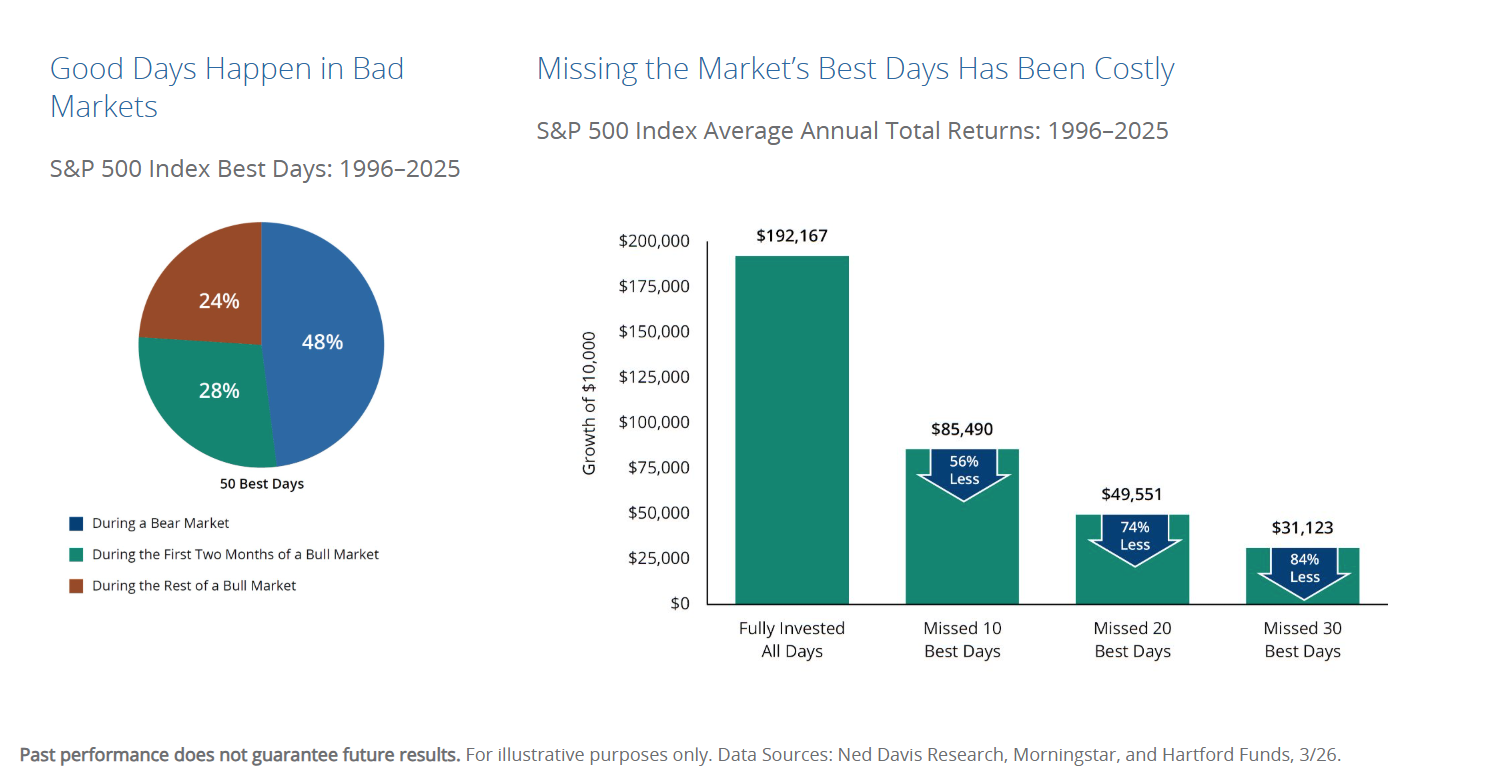
While the instinct to raise cash ahead of a feared downturn feels prudent in the moment, in reality it requires being right twice, once on the way out and again on the way back in, and most investors who attempt it get neither timing right. Not only that, but some of the best days in the markets happen during bear markets. In fact, looking at the below data, we see that almost half of the best days between 1996 and 2025 happened during bear markets. And if you missed just 10 of the best days during this time, your performance was cut by more than half.
Can traders make money timing the market? Absolutely. But we have found this to be the exception and not the rule.
Hope you have a great week, and remember, volatility is the price of admission.
